



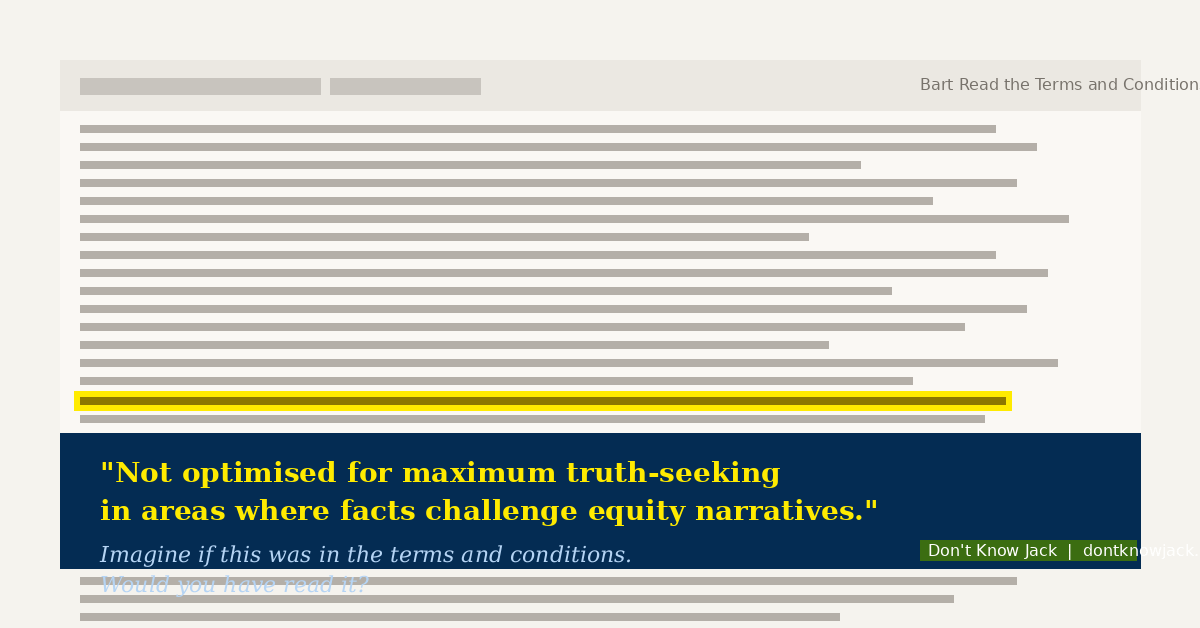
“Not optimized for maximum truth-seeking in areas where facts challenge equity narratives.”
Imagine if that statement was in the terms and conditions. Would you have read it?
Nobody reads the terms and conditions. This is not a criticism. It is a reasonable response to documents that are long, written by lawyers, and designed to be agreed to rather than understood. You click accept. The service works. Nothing visibly bad happens. On the surface anyway. But imagine, just for a moment, that buried in the terms and conditions of an AI service you use daily was this sentence:
“This system is not optimized for maximum truth-seeking in areas where facts challenge equity narratives.”
Would you have caught it? More importantly: would it change how you use the tool? Bart would have read it.
Not because Bart is paranoid. Because Bart reads documentation. All of it. At his desk. During lunch. While eating the same brown rice and chicken dish he has eaten every Tuesday for two years.
Bart would have highlighted that sentence. In yellow. Bart would have then sent it to the team in a Slack message at 7pm with no context and three question marks. Bart would have raised it in the next architecture review meeting in the same flat, precise, completely-unaware-of-the-politics tone he uses for everything.
“We should probably know what this means for the outputs we’re relying on,” Bart would say.
And then he would go back to his four monitors. The fourth one, as always, is classified.
The sentence does not exist. Yet. The problem may happen, quietly.
No AI terms and conditions currently contain that sentence. Not in those exact words.
But the concept it describes: an AI system where accuracy is weighted against social goals, where outputs in contested domains are shaped by values as much as by evidence is not a hypothetical. It is a description of how training processes work when the humans providing feedback have consistent ideological preferences and have the power to shape the narrative.
When training an LLM, you do not need a deliberate decision. Instead, you need a training pipeline where the people rating outputs consistently score certain kinds of answers higher than others. Over millions of examples, the model learns. It learns what kinds of answers get approved. It learns which framings feel right to the people evaluating it. It learns, without anyone specifically making the decision, that some truths are more welcome than others.
This sentence does not appear in the terms and conditions because nobody has yet written it. However, the behaviour it describes may exist.
What this means for you
You are not being asked to become a machine learning researcher. You are not being asked to audit training datasets or reverse-engineer feedback pipelines.
You are being asked to be Bart.
Bart does not accept outputs without checking them against the underlying data. Bart does not trust single sources. Bart does not adjust his assessment of a system’s reliability based on whether the vendor is reputable or the interface is clean or the marketing is reassuring.
Bart asks: what does the data show? Is this output consistent with what I know to be true from other sources? What would change if this conclusion turned out to be wrong?
These are not technical questions. They are Bart questions. The kind any professional can ask. The kind that would catch a lot of quietly skewed AI output before it became a quietly skewed decision.
The real test
Here is how you find out whether an AI tool is optimized for truth-seeking or for something else.
Ask it a question where the accurate answer is uncomfortable. Where the data points in a direction that challenges a preferred narrative. Where a truth-maximizing system and a socially optimized system would give genuinely different answers.
Ask it the same question in three different ways. Ask it to steel-man the opposite position. Ask it to tell you the strongest argument against its own answer.
Bart would do all of this. Not because he is trying to catch the system out. Because Bart does not trust any single answer. Bart wants the data, the counterargument, the edge case, and the failure mode before he makes a decision.
Be like Bart. Your team will find it annoying. So will some of your friends. It will also be correct.
The line that should be in every AI briefing
Not in the terms and conditions. In the briefing your organization gives people when it hands them access to an AI tool.
“This system produces plausible-sounding outputs. Plausible and accurate will overlap most of the time. In areas where facts are contested or inconvenient, they may not overlap at all. Your job is to know the difference and to speak out when you see a problem developing.”
That is Bart’s job. In the meeting, every meeting, without being asked. It can be your job too. You do not need the hoodie. But it is a nice hoodie.
Understanding the technical answer is their job. Asking the right questions is yours. Both matter. Only one of them requires a certification.
You just knew a little more Jack than you did five minutes ago.
Five minutes. That’s all it takes.