

Bart Counts the Cores
VM size is a cost decision, not a lucky number

Selena walked into the Tuesday 10 o’clock meeting still slightly out of breath. The parking lot lines were being repainted yellow. She had decided not to risk her new whitewall tires and had walked instead. Her notebook was already open.
“Pierre called from Paris,” she said. “Spindle de Provence has been added to the SuperExtreme wedding package. BioVoom needs a virtual machine for the design software. Specs are fast and redundant and in the right Azure region for Europe. He needs an answer today.”
JJ nodded. He heard Paris.
Selena picked the VM while JJ watched
Selena filtered server available in West Europe, sorted by cores, and stopped on the Standard_D32s_v5. Thirty-two cores. 128 GB of RAM. Sixteen was her lucky number. She doubled it for good measure.
“That’s a lot of cores,” JJ said. “Looks powerful.”
Selena approved the deployment and closed her laptop. JJ wrote ‘cores are powerful’ on a gold Post-it note. He underlined powerful twice.
Bart’s cost dashboard noticed
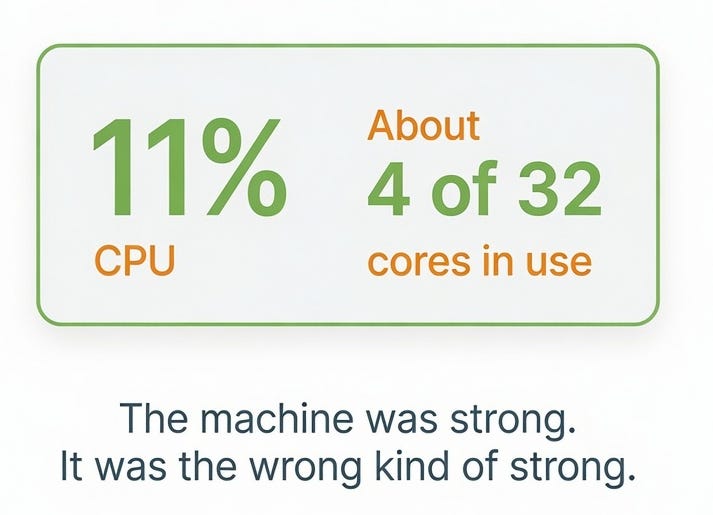
At 2:47 p.m. the following Monday, a cost alert appeared on Bart’s phone. CPU utilization on the new VM had not gone above 11%. The design software was running. It was not using thirty-two general purpose cores. It was performing graphics work on a machine built for something else.
Bart posted to #infrastructure general.
“The Standard_D32s_v5 for BioVoom is oversized. CPU at 11% - about 4 of 32 cores in use. This workload needs GPU acceleration and high availability. Reviewing options.”
Raja replied in four minutes.
“More cores means more capacity. More capacity means more speed. I took an online class on CPU speeds. We should add autoscaling for peak wedding season overload.”
Bart checked the Cost Explorer recommendations on his fourth monitor. He drained the last of his warm Jolt Cola and answered.
“Autoscaling adds capacity when demand rises. Workload is running at 11%. Autoscaling will not fix the wrong machine type.”
Selena said, “I forgot to mention that they are using a 3D printer to engrave the spindles in house.”
JJ selected a fresh gold Post-it note.
“If I went to Paris I could hand roll the first customer’s order,” he said. “It’s all about the personal touch with weddings.”
Bart made sure he did not look up as he spoke.
“The software is running in the cloud. A 3D printer does not replace the right GPU. Two smaller GPU servers behind a load balancer will do the job.”
Raja paused. He then nodded. Slowly.
“Two smaller servers. And if one fails, the other keeps going. I see it.”
JJ wrote ‘load balancers lack empathy so which server lives is redundant’ on the Post-it note and stuck it to the first one.
Cores and GPUs
An iPhone 17 Pro has six CPU cores that can handle everyday tasks such as email, browsing, and messages when multiple apps are open and running. Any CPU ever created has at least one core.
A GPU is a different kind of processor. It is built for parallel visual work such as graphics, rendering, and certain kinds of AI. Design software that etches names onto spindles in gold and silver is graphics work that a CPU can still perform. But a GPU does it much faster.
GPU servers still have CPU cores for basic processing. They also have a GPU for rendering graphics. Running graphics software on a server with thirty-two general purpose cores and no GPU is like buying the newest iPhone and expecting it to replace a Sony mirrorless camera used for professional wedding photography. You paid for power. You did not pay for the right power.
The machine was strong. It was the wrong kind of strong.
What Bart rebuilt
Two smaller GPU servers in West Europe. Four cores each, GPU optimized for graphics (Standard_NC4as_T4_v3). Modest servers with a dedicated GPU that performed the design work. Placed behind an Azure Load Balancer so if one server failed, the other was available to take over.
Azure Blob storage was used for storing the spindle designs. The servers did the graphics work. Object storage stored the designs.
The correct server design even with redundancy cut the monthly bill in half before anyone negotiated a discount.
For more savings, he set automatic shutdown at 11 p.m. and automatic start at 7 a.m. European time. Nobody was engraving spindles at 2 a.m. Yet. The overnight stop cut another share of the monthly cost.
Nobody talked about 3D printing again. JJ’s offer to hand roll the first order was not answered by Pierre.
Bart posted once more.
“BioVoom environment rebuilt. Two GPU servers behind a load balancer. Designs stored safely in Azure Blob storage. Automatic shutdown on. Pierre can be informed.”
Three people read it. A record. JJ smiled.
Selena wrote ‘sort by workload, not by cores’ in her notebook.
The Paris question
“Someone should walk Pierre’s team through the new setup,” Selena said. “Bart and I could go. I know the area.”
JJ looked at his phone again.
“I will go. I own the European relationship, and I have never been to Paris. And I have United points that are about to expire.”
Bart had been planning a quiet weekend. He did not want to explain load balancers over dinner at a bistro that did not serve burgers and fries.
Selena wrote something in her notebook and did not show anyone.
JJ booked his travel before the meeting ended. He used all his points on the three overnight connecting flights and was only out $15.25.
What the VM decision was
The Standard_NC4as_T4_v3 is a GPU optimized Azure server built for graphics and similar work. It has a CPU for regular processing and a GPU for the graphics work.
Two smaller correctly sized servers behind a load balancer cost less than one of the wrong large servers. If one fails, the other was available to take over. BioVoom’s clients can get their spindle designs printed before the morning of the wedding.
A large number of cores is never the first answer. The right fit for the process is always the answer.
Three questions worth asking before the next VM goes live
What does this workload need: CPU cores, GPU acceleration, memory, or storage?
Is this VM running overnight or on weekends when nobody is using it?
Would two smaller servers behind a load balancer cost less and fail less than one large one?
Ask. Understand. Connect. Belong.
The daily concept, question, and rationale arrive at dontknowjack.club every weekday. Selena’s Crossword every Sunday. Free. No credit card.